
To become a school social worker in California, you need a Master of Social Work (MSW) degree and a Pupil Personnel Services Credential (PPSC) with a School Social Work specialization, issued by the California Commission on Teacher Credentialing. The PPSC — not an LCSW license — is generally required for working in California’s TK–12 public schools.
California has roughly one school social worker for every 6,132 students. The recommended ratio is 1 to 250. That gap isn’t a statistic, it’s thousands of kids navigating trauma, housing instability, chronic absence, and family crisis without the advocate they need. School social workers are the professionals trained to bridge that distance, working inside California’s public school system where few others can reach. If you’re drawn to this work, here’s what the path looks like, and why it’s different from what most people expect.


What School Social Workers Do in California
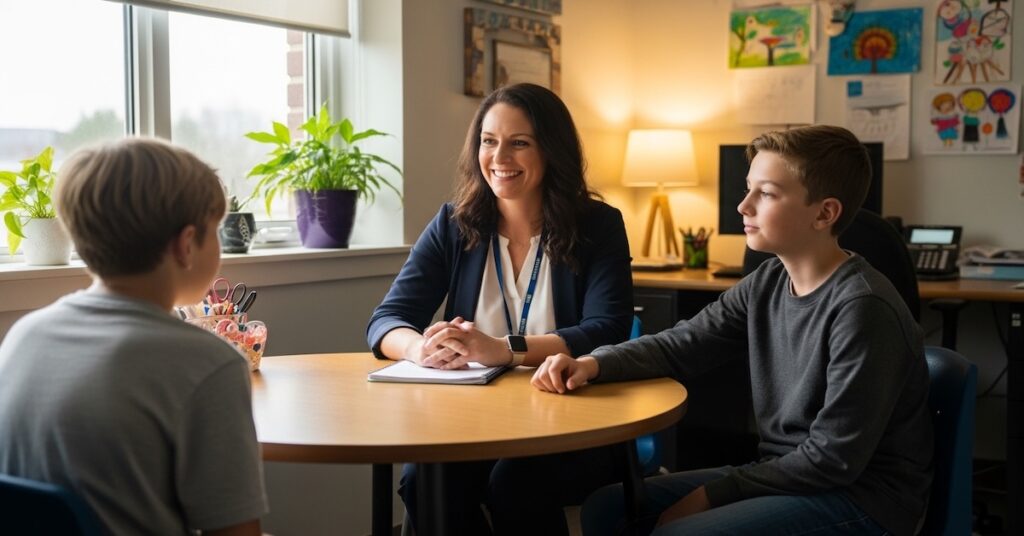
School social workers in California are embedded in TK–12 public schools as part of the educational support system. They work at the intersection of student mental health, family engagement, and community services, not as therapists in the clinical sense, but as systems-navigators who understand both the educational and social service landscapes.
In practice, that means responding to attendance crises before they become dropouts. It means recognizing when a student’s behavior issues are rooted in domestic violence at home. It means connecting families with housing resources, coordinating with child protective services, and supporting students with disabilities through IEP processes. California’s community schools initiatives have expanded this role further, positioning school social workers as key links between schools, families, and outside agencies.
The role is framed around a person-in-environment perspective, the same lens that defines school social work in California broadly. In a school setting, that means looking at a child not just as a student struggling in class, but as a person shaped by their family, neighborhood, economic circumstances, and community.
The PPS Credential: Your Required Authorization
To work as a school social worker in a California TK–12 public school, you generally need a Pupil Personnel Services (PPS) Credential with a School Social Work specialization. This credential is issued by the California Commission on Teacher Credentialing (CTC), the same body that credentials teachers, not by the Board of Behavioral Sciences that governs LCSW licensure.
This distinction matters. Many people entering social work assume that an LCSW is the credential needed to work in schools. It isn’t. The LCSW is a clinical license that authorizes independent psychotherapy. The PPS credential authorizes you to work within California’s public school system in an educational support role. They’re governed by different bodies, serve different purposes, and are earned through different processes.
What the PPS Credential Requires
To earn the PPS credential in School Social Work, California candidates typically need to complete all of the following:
| Requirement | Details |
|---|---|
| MSW Degree | From a CSWE-accredited program; must include or be supplemented by CTC-approved PPS coursework in School Social Work |
| PPS Program Completion | Varies by program; often completed within an MSW or as a post-MSW certificate (commonly ~24–48 units depending on structure) |
| Supervised Field Hours | At least 450 hours of supervised fieldwork in California public school settings (many programs require more), spanning at least two grade levels, typically supervised by a professional holding a PPSC or equivalent school-based credential per program and CTC requirements |
| Certificate of Clearance | California background check via Live Scan fingerprinting; required before starting field placements at most programs |
| Program Recommendation | Your CTC-approved program must formally recommend you for the credential upon completion |
| CTC Application and Fees | Submit directly to the California Commission on Teacher Credentialing with required documentation |
The Child Welfare and Attendance (CWA) Add-On
Many California programs bundle the School Social Work PPSC with a Child Welfare and Attendance (CWA) authorization. This add-on expands your authorization to include attendance-focused roles within school districts. This is a growing area given California’s chronic absenteeism problem. If your program offers both, it’s worth completing. The CWA doesn’t require significant additional coursework and meaningfully broadens your employability, including in roles that overlap with child welfare social work at the district level.
PPS Credential vs. LCSW: What’s the Difference?
This is the question almost every prospective school social worker has, and it deserves a direct answer. The PPS credential and the LCSW license are not interchangeable. They serve different functions, fall under different regulatory bodies, and are required in different settings.
| Aspect | PPS Credential (School Social Work) | LCSW License |
|---|---|---|
| Issuing Body | California Commission on Teacher Credentialing (CTC) | California Board of Behavioral Sciences (BBS) |
| Primary Purpose | Authorization to work as a school social worker in TK–12 public schools and district programs | Clinical license to diagnose, treat mental disorders, provide psychotherapy, and practice independently |
| Required Degree | MSW plus CTC-approved PPSC program and school-based field education | MSW from CSWE-accredited program plus 3,000 supervised clinical hours and two BBS licensing exams |
| Where Required | TK–12 public schools in California (generally required) | Community mental health, hospitals, private practice, and some school-linked clinical programs |
| Can You Practice Independently? | No — authorizes school employment, not independent clinical practice | Yes — full clinical practice rights, including opening a private practice |
| Required for K–12 School Social Work? | Generally yes for public school employment | No — but some districts prefer or require it for clinical leadership roles |
Many California school social workers eventually hold both credentials. The PPSC gets you into schools; the LCSW gives you options outside of them, everything from private practice to community mental health or hospital settings. That makes it valuable for advancement into clinical leadership within school-linked programs. If long-term flexibility matters to you, pursuing both is worth planning for. You can learn more about the full California social work licensing process on this site.
Steps to Become a School Social Worker in California
The path has a clear structure, though the timeline varies depending on whether you complete PPS coursework during your MSW or as a post-graduate add-on.
Step 1: Earn a Bachelor’s Degree
A BSW is not required to enter an MSW program, though some programs offer advanced standing to BSW graduates, allowing them to complete the MSW in one year instead of two. Any accredited bachelor’s degree can meet the admission requirement for most California MSW programs.
Step 2: Complete a CSWE-Accredited MSW Program with PPS Preparation
This is the most critical step. Not every MSW program in California is CTC-approved to offer the PPS credential in School Social Work. You need to specifically select a program that either embeds the PPSC coursework in the MSW curriculum or has a clear post-MSW pathway. Check each program’s credentials page carefully. The CTC maintains an official list of approved preparation programs. Your MSW field education hours may count toward PPS fieldwork requirements if your program’s placements are in California public school settings (required for CTC eligibility).
Step 3: Complete School-Based Field Hours
At least 450 supervised hours in California public school settings are required (many programs require more), spanning at least two grade levels. This requirement is why out-of-state MSW graduates often need to arrange additional fieldwork after moving to California since their prior internships were likely not in California public schools under a PPSC-holding supervisor.
Step 4: Obtain Your Certificate of Clearance
Before starting school-based fieldwork at most programs, you’ll need a Certificate of Clearance from the CTC, which involves a background check processed via Live Scan fingerprinting. Apply for this early. Processing can take several weeks, and many programs require it before your first day in a school placement.
Step 5: Receive Program Recommendation and Apply to the CTC
Once you’ve completed all program requirements, your program director will submit a recommendation to the CTC on your behalf. You then apply directly to the CTC with your documentation and fees to receive your PPS credential in School Social Work.
What If I Got My MSW Out of State?
If you completed your MSW in another state, you likely still need to complete PPS-specific coursework and California school-based field hours before applying for the PPSC. Some California programs offer post-MSW credential-only pathways designed specifically for MSW graduates who need to add the PPS credential. The CSU San Marcos MSW is one example of this. Expect around 12+ units of additional coursework depending on prior coursework alignment, plus the supervised California school fieldwork hours.
MSW Programs with School Social Work Tracks in California
Not all California MSW programs are approved by the CTC to offer PPS preparation. Programs that have historically offered or currently offer PPSC pathways in School Social Work include the following. When evaluating any program, confirm directly with the school that their PPS program is currently CTC-approved and that school-based field placements can be arranged in California public school settings.
| Program | PPS Pathway | Notes |
|---|---|---|
| University of Southern California (USC) — Suzanne Dworak-Peck School of Social Work | MSW with school social work training; graduate certificate in Trauma-Informed Interventions in Educational Settings | Strong emphasis on school-based trauma practice (CBITS, Bounce Back); one of California’s largest MSW programs |
| San Francisco State University (SF State) | MSW with integrated PPSC option in School Social Work | Authorizes pre-K through 12; Children, Youth & Families concentration; urban practice focus |
| San Diego State University (SDSU) | PPS credential integrated into MSW or available post-MSW | Practicum requires ~20 hours/week in approved school sites; specified PPS coursework required |
| CSU San Marcos (CSUSM) | Post-MSW PPSC in School Social Work and CWA | Requires completed MSW plus documented PPS-qualifying internship hours at two age levels; well-suited for out-of-state MSW grads |
| Sacramento State (Sac State) | Post-MSW PPSC option; school-based field placements required | Students often complete PPS coursework after MSW graduation; verify current CTC approval status directly with program |
| CSU Long Beach (CSULB) | PPSC in School Social Work and CWA available | MSW program with school track; confirm current integrated vs. post-MSW structure with program directly |
| CSU Fullerton (CSUF) | PPSC in School Social Work and CWA | Post-MSW option available; verify field placement requirements with program directly |
The CTC maintains the official registry of approved PPS preparation programs. Always verify current approval status before enrolling. Program offerings can change between academic cycles.
School Social Worker Salary in California
California’s Child, Family, and School Social Workers (the BLS occupational category that includes school-based social workers) earn among the highest wages in the country for this specialization. Below are statewide figures and a selection of California metro areas from the most recent BLS data.
California Statewide — Child, Family, and School Social Workers
| Specialization | 10th Percentile | 25th Percentile | Median | 75th Percentile | 90th Percentile |
|---|---|---|---|---|---|
| Child, Family, and School Social Workers (CA Statewide) | $46,980 | $54,890 | $69,250 | $88,190 | $102,460 |
Select California Metro Areas — Child, Family, and School Social Workers
| Metro Area | 10th Percentile | 25th Percentile | Median | 75th Percentile | 90th Percentile |
|---|---|---|---|---|---|
| Los Angeles–Long Beach–Anaheim | $47,390 | $55,680 | $76,600 | $98,530 | $104,040 |
| San Francisco–Oakland–Fremont | $53,440 | $58,620 | $71,810 | $99,210 | $124,050 |
| San Jose–Sunnyvale–Santa Clara | $54,890 | $62,630 | $78,700 | $102,440 | $125,840 |
| Sacramento–Roseville–Folsom | $47,300 | $51,190 | $66,610 | $74,060 | $94,280 |
| San Diego–Chula Vista–Carlsbad | $47,330 | $54,420 | $61,420 | $76,960 | $88,190 |
| Riverside–San Bernardino–Ontario | $41,500 | $49,950 | $64,270 | $76,250 | $97,430 |
Public school district positions often include additional compensation in the form of benefits, pension contributions through CalSTRS or CalPERS, and summers off. These are all factors that affect total compensation beyond base salary. California has also invested in workforce pipeline funding through programs like CalSWEC (California Social Work Education Center) stipends and California Department of Education workforce grants, which provide financial support for students in school social work programs who commit to working in California schools after graduation. Check with your program directly for current funding opportunities.
Frequently Asked Questions
Do I need an LCSW to be a school social worker in California?
No. The generally required credential for working as a school social worker in a California TK–12 public school is the Pupil Personnel Services Credential (PPSC) with a School Social Work specialization, issued by the California Commission on Teacher Credentialing. An LCSW is a clinical license issued by a separate board — the Board of Behavioral Sciences — and is not required for school-based roles, though many school social workers eventually pursue both.
Can I earn my PPS credential while I’m in an MSW program?
It depends on the program. Some California MSW programs , including the SDSU and SF State, integrate PPS coursework and school-based field placements into the MSW curriculum, allowing you to graduate with both. Others, including Sacramento State and CSU San Marcos, offer the PPSC as a post-MSW add-on. When comparing programs, ask specifically whether PPS preparation is embedded in the MSW or requires additional time after graduation.
What if I completed my MSW in another state?
Out-of-state MSW graduates who want to work in California schools typically need to complete the 12+ units of additional PPS-specific coursework, and arrange qualifying California school-based fieldwork hours before applying for the PPSC. Several California CSU programs offer post-MSW PPS credential pathways specifically designed for this situation. Your existing MSW from a CSWE-accredited program satisfies the degree requirement, but the PPS coursework and in-state fieldwork cannot be waived.
Should I choose school social work or school counseling?
Both paths require a PPS credential, but from different degree programs. School social workers hold an MSW and bring a person-in-environment framework focused on family systems, community resources, and social determinants. School counselors typically hold a master’s in counseling and focus on academic planning and career development. Some California MSW graduates with a PPSC also qualify for certain community college counseling roles. If your focus is on mental health support, family advocacy, and connecting students to community services, the school social work path is typically the stronger fit.
Is there demand for school social workers in California?
Yes — substantially. California’s current social worker-to-student ratio in schools is approximately 1 to 6,132, compared to the recommended 1 to 250. The state has increased funding through community schools initiatives and mental health investments, actively adding positions in districts across California. The gap between where ratios are and where they should be represents genuine, sustained demand for trained, credentialed school social workers.
Key Takeaways
- ✓The PPS Credential is the required authorization — not the LCSW — for working as a school social worker in California TK–12 public schools, issued by the California Commission on Teacher Credentialing.
- ✓Program selection is critical — only MSW programs with CTC approval can prepare you for the PPSC, and some offer it embedded in the MSW while others require a post-MSW add-on.
- ✓Out-of-state MSW graduates aren’t shut out — but they typically need 12+ additional units and California school-based field hours before applying for the PPSC.
- ✓Many school social workers hold both credentials — the PPSC for school employment and the LCSW for clinical portability and expanded career options outside K–12.
- ✓Demand in California is significant — with a 1:6,132 social worker-to-student ratio against a 1:250 recommendation, the need for trained school social workers across the state is not a talking point; it’s a documented crisis.
California’s schools need social workers who see students as whole people shaped by their families, neighborhoods, and circumstances, and with the training to act on that understanding. Find the MSW program that prepares you for that work.
2024 US Bureau of Labor Statistics salary and employment figures for Social Workers, Social and Human Services Assistants, Social and Community Service Managers, and Substance Abuse, Behavioral Disorder, and Mental Health Counselors, reflect state and national data, not school-specific information. Conditions in your area may vary. Data accessed April 2026.